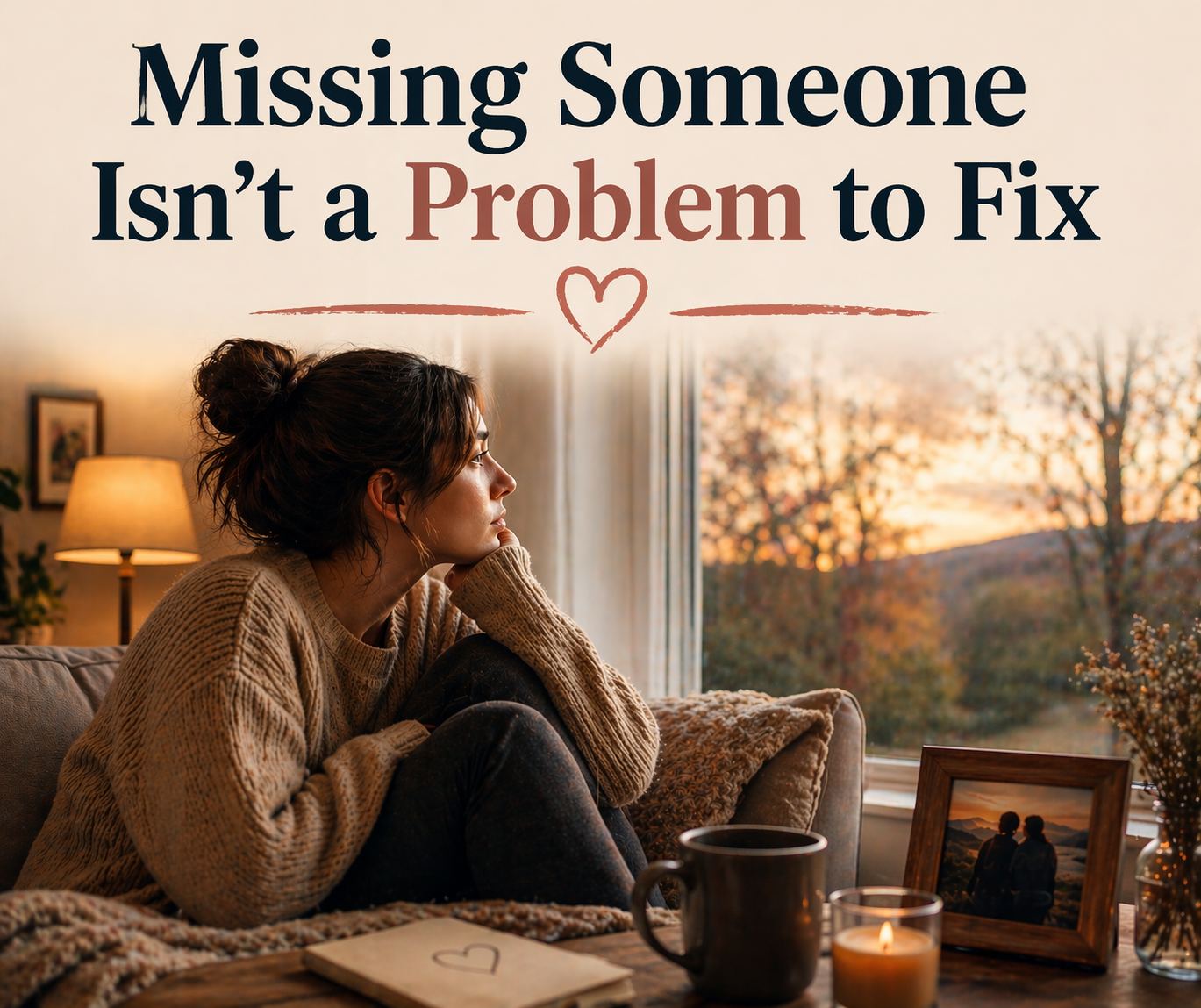
There's a post floating around social media right now that basically says if you miss your partner when they're not around, that's a sign of unhealthy dependency.
I've seen versions of this framing pop up constantly, and I think it's doing real damage to the way people interpret their own feelings.
So let's break this down properly.
The Internet Loves a Diagnosis
We live in a time where pop psychology has gone completely mainstream. Terms like "codependency," "anxious attachment," and "emotional dysregulation" have jumped from clinical settings into everyday conversation. That's not all bad. People are more emotionally aware than ever.
But there's a problem when those terms get stripped of their actual meaning and applied to anything that looks like strong feeling or need in a relationship. At that point, we're not spreading awareness. We're just pathologizing normal human experience.
Missing someone when they leave the room is not a disorder. Wanting to spend time with your partner is not a red flag. Feeling a pull toward someone you love is not something that needs to be corrected.
What Codependency Actually Is
Codependency has a real clinical definition. It describes a pattern where one person's sense of identity, emotional stability, and self-worth is completely contingent on another person. It often involves enabling destructive behavior, losing yourself in a relationship, inability to make decisions independently, and measuring your own value entirely through how the other person sees you.
That is a real issue. It can cause serious harm to both people in the relationship. Therapy and self-work are genuinely helpful for people dealing with it.
But "I missed April when she was out of town for a few days" is not that. Not even close.
The conflation of those two things is where the internet gets it wrong.
What the Science Actually Says
Attachment theory, developed by psychologist John Bowlby and later expanded by Mary Ainsworth, describes how humans form emotional bonds. One of the core findings is that securely attached people actively seek closeness with their partners and feel discomfort during separation.
That discomfort is not pathology. It is the biological signal that the bond is real.
When you're around someone you love, your brain releases oxytocin, often called the bonding hormone. It reinforces the connection and makes proximity feel rewarding. Dopamine plays a role too, activating the brain's reward circuits in response to that person's presence.
When they're gone, those signals quiet down. You notice the absence. That's not dysfunction. That's your nervous system accurately reporting that something meaningful is missing temporarily.
Ainsworth's research identified secure attachment as the healthiest attachment style. And securely attached people miss their partners. They want to return to them. They prioritize the relationship. None of that looks like the detached, hyper-independent ideal that social media sometimes promotes as the goal.
The Difference Between Healthy Longing and Unhealthy Dependency
There is a line here, and it is worth knowing where it is.
Healthy longing looks like this: you miss your partner, you feel glad when they're back, you enjoy your time together, and you're also capable of functioning, maintaining your own identity, and being okay when you're apart. The relationship adds to your life. You are still you without it, but you prefer having it.
Unhealthy dependency looks like this: you cannot function without the other person present, your emotional state is entirely controlled by their moods and actions, you have no sense of self outside the relationship, and separation triggers a level of panic or desperation that disrupts your daily life.
One of those is a healthy, secure bond. The other is something worth examining with a professional.
If you feel genuinely happy to see your partner after they've been away, you are not broken.
You are connected.
Why This Framing Is Worth Pushing Back On
When we label normal emotional responses as unhealthy, a few bad things happen.
First, people start suppressing real feelings because they've been told those feelings are a problem. They pull back from their partners, perform emotional distance, and mistake detachment for health.
Second, it creates an impossible standard. The logic of some of this content seems to suggest that truly healthy people don't really need anyone, don't miss anyone, and maintain perfect emotional equilibrium regardless of who is or isn't in their life. That's not emotional health. That's avoidant attachment dressed up as self-sufficiency.
Third, it erodes actual intimacy. Vulnerability, longing, and emotional need are the building blocks of real connection. When you teach people to treat those things as weaknesses, you don't produce healthier relationships. You produce shallower ones.
The Bottom Line
Not every feeling is a symptom. Not every emotional need is a dependency problem. Not every strong connection is a red flag.
Sometimes missing someone just means you've built something real with them. That's the point of a relationship. That's what you're going for.
The goal was never to care about someone so little that their absence doesn't register. The goal is to build a bond strong enough that it matters when they're not there, and secure enough that you can handle it when they're not.
That's healthy. That's human. And it doesn't need a label.