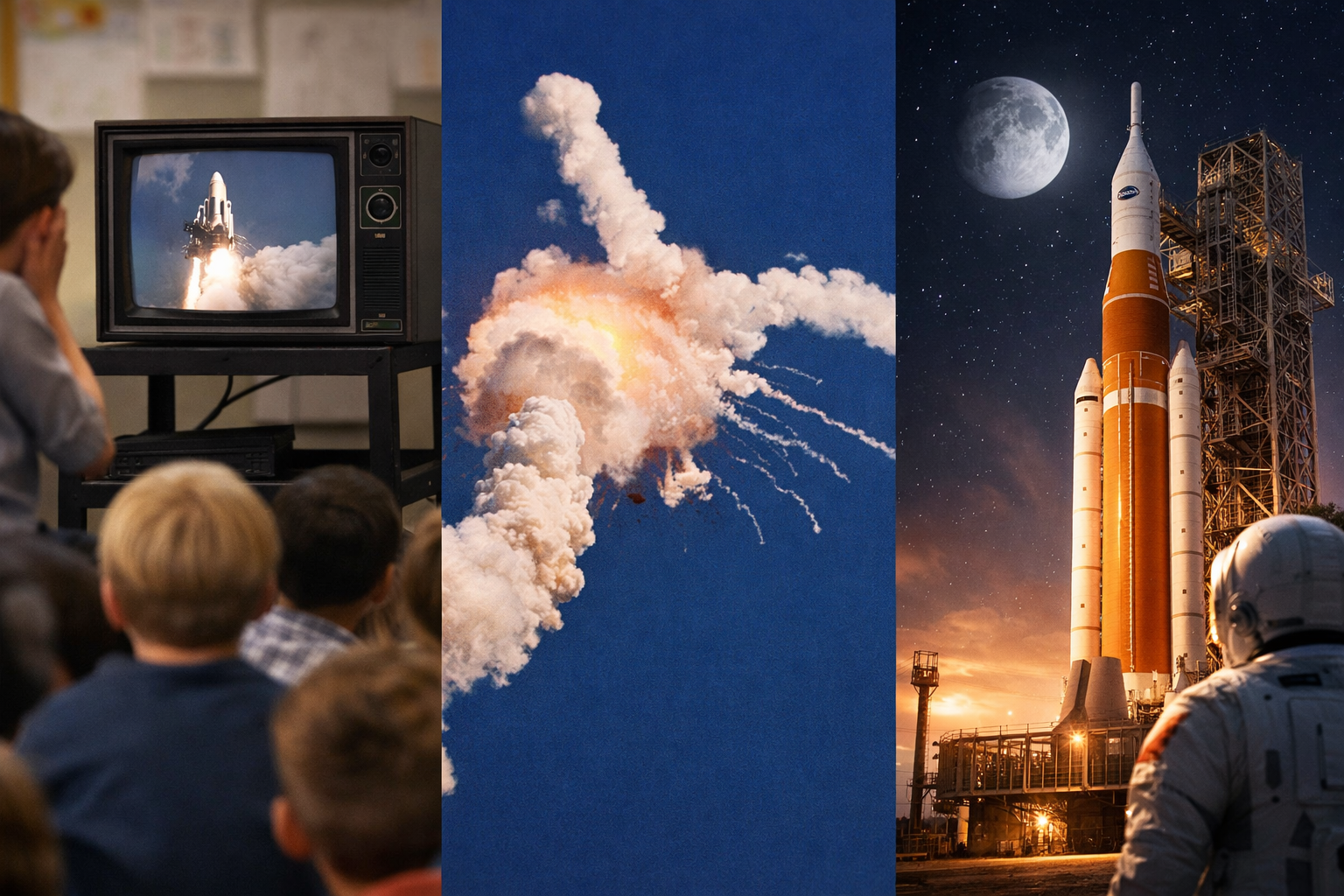
I was in kindergarten when the teacher rolled in that TV on the metal cart.
If you grew up in that era, you know, that wasn't casual. That meant something important was about to happen.
The room felt different. Louder, but quieter at the same time. Kids whispering. Chairs shifting. That hum of anticipation you don't really understand until you're older.
We weren't watching a movie.
We were watching a launch.
The Space Shuttle Challenger disaster.
Back then, space felt magical. Untouchable. Like it belonged to another world entirely, but somehow, we were part of it.
⸻The Sound of Excitement
The countdown echoed through that little classroom TV speaker.
Static. Crackle. That unmistakable broadcast tone from the 80s.
And then ignition.
A pillar of fire lifting something impossibly large into the sky.
It didn't feel dangerous. It felt powerful. Clean. Certain.
Like humans had figured it out.
Like we had conquered something.
⸻The Moment That Didn't Make Sense
And then… something broke.
Not just in the sky.
In the room.
At first, nobody reacted. Because nobody understood what they were seeing.
It wasn't supposed to look like that.
The adults didn't explain anything right away. They just stared.
And when adults go silent like that, it changes everything.
The excitement drained out of the room so fast it felt physical. Like pressure dropping.
We didn't have the words, but we knew.
Something wasn't right.
⸻That Feeling Never Really Leaves
As a kid, you don't process tragedy the same way.
You remember the feeling.
The shift.
The contrast between what something was supposed to be… and what it became.
That moment stayed with me, not because I understood it, but because it changed how I felt about space.
It introduced something new.
Weight.
⸻Fast Forward — And We're Here Again
Now here we are, decades later, standing on the edge of another moment.
But this time, it's different.
The Artemis II mission isn't just another launch.
It's the beginning of something we haven't done in over 50 years.
We're not just going to orbit Earth.
We're leaving it.
⸻What We're About to Do (And Why It Matters)
Artemis II is designed to send humans farther than we've gone since the Apollo era.
Not low Earth orbit. Not the space station.
We're talking about traveling thousands of miles beyond Earth's orbit… slingshotting around the Moon… and coming back.
Think about that.
Humans leaving the gravitational comfort zone we've been operating in for decades.
Crossing into deep space again.
And this isn't just a one-time stunt.
This is step one of something bigger:
Establishing a long-term human presence around the Moon
Building infrastructure for future missions
Testing systems that will eventually take humans to Mars
This is no longer about proving we can go.
It's about building a future where going is normal.
⸻Why This Feels Different Than It Did Back Then
Back in that classroom, space felt like magic.
Now, it feels like engineering, risk, precision… and intention.
We understand more.
We've learned from moments like Challenger.
Every bolt, every system, every decision carries the weight of everything that came before it.
That changes how you watch a launch.
It's not blind excitement anymore.
It's respect.
⸻From That Classroom to This Moment
I still think about that TV on the cart.
That feeling of "we're about to see something big."
And in a strange way, that feeling is back.
But now it's layered.
Excitement… with understanding.
Hope… with history behind it.
⸻And This Time…
When Artemis II launches, I'll be watching again.
Not as a kid.
Not without context.
But with something better.
The same wonder… just sharpened by experience.